
In short: Start by reading your own site to find the pages that make you money. Then pick one goal and repeat the same few steps every month: plan, write, link to those pages, and measure.
Key takeaways
- SEO is steady monthly work on pages that answer your customers’ questions, and nobody can promise a ranking or a date.
- Searches where you sit on page two of Google are often the quickest to move.
- One goal a month keeps every article and link pulling in the same direction.
- Links from articles to your money pages lead readers towards booking or buying.
- With BiasharaPilot, nothing goes live until you approve it, and every change has an Undo.
You know your trade well, and you’ve heard more than once that you need to show up on Google.
For you, getting started means one short routine a month, built around the pages that already bring you work. It doesn’t mean a second job learning jargon.
SEO takes time to show. New pages often need a few weeks to a few months to find their place. But once they do, they keep answering your customers’ searches long after you publish them.
By the end of this post, you’ll be able to write down your first goal and choose whether to do the work by hand, with a tool, or with a team.
What is SEO for a small business?
SEO, short for search engine optimisation, is the work of helping Google show your pages to people searching for what you sell. The searches that matter are the ones your customers type, like “water heater repair Austin” or “why is my water heater leaking”.
Say you run a plumbing business in Austin, Texas. For you, SEO means that when a homeowner in Round Rock wakes up to a cold shower and searches for help, one of your pages answers them and gives them a reason to call.
Is SEO a trick or steady work?
Many business owners we speak to picture SEO as a trick: a hidden setting, or a list of words that pushes a site to the top. That’s an easy belief to pick up, because plenty of advice online is sold that way.
What works is plainer. You publish pages that answer your customers’ questions well and link them to each other.
Then you keep doing it month after month, so Google has more reasons to trust your site over time.
What SEO can and can’t do for you
SEO can put you in front of people who are already looking for what you do. It can’t decide where Google places you, because Google sets the order of results.
So anything we say about rankings is advice, never a promise of a position or a date.
A worry we often hear is “I don’t know SEO, so I’ll get it wrong.” We understand that.
But the hardest part of SEO is knowing what customers ask, what they worry about and which jobs pay best, and you know those better than any agency.
Start by reading your own site
Before you write anything new, look at what you have. Your site may already hold a few pages doing quiet work, and early gains often come from helping those pages rather than starting over.
List what you already have
Open your site and write down every page: home, services, products, about, contact and any blog posts. For the Austin plumber, that might be a home page, five service pages and three blog posts from two years ago.
Next to each page, note what it’s for and when you last changed it.
Old pages aren’t a problem. They’re material you can improve.
Find the pages that make you money
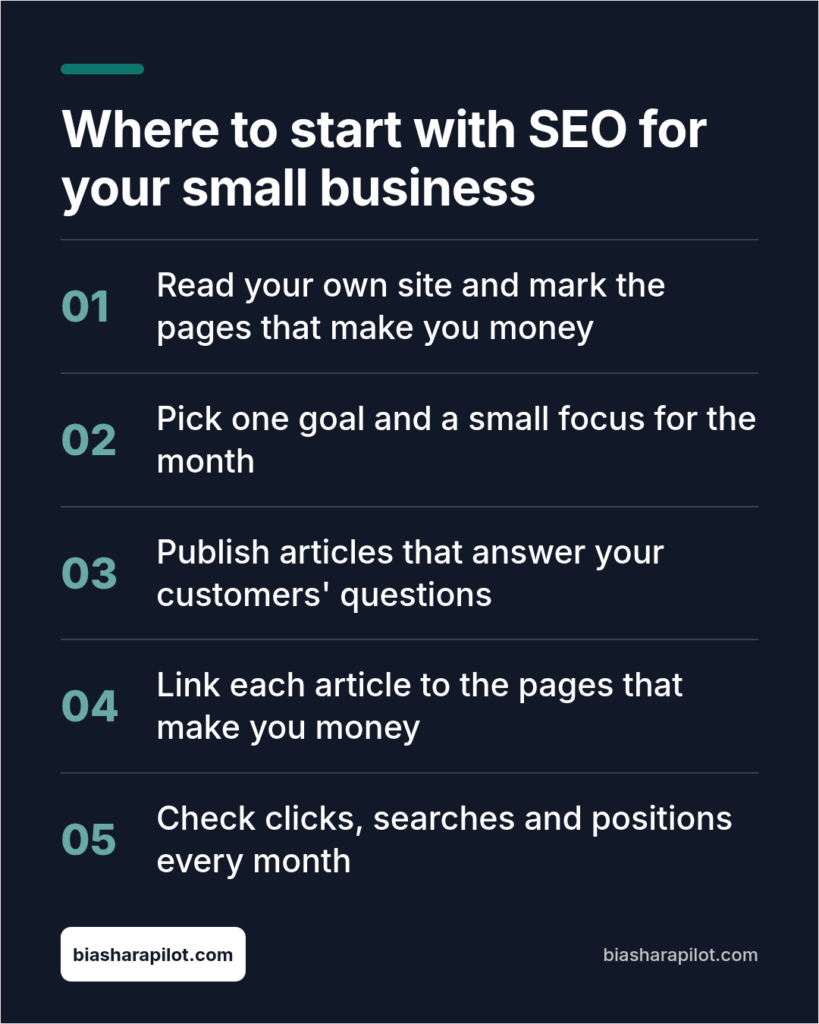
The pages that make you money are the ones a customer visits before they call, book or buy. Your own records help here: ask new customers how they found you, and check which service or product brings the most enquiries.
Say most of your best-paid jobs are water heater installs. Your water heater page is then a money page, and much of your SEO work will point visitors towards it.
See who’s on page one, and where you’re close
Search on Google for the five or six things your customers type, and note who’s on page one, the first ten results. Look at what their pages do: do they answer questions, show what the job involves, explain the steps?
Then open Google Search Console, a free tool from Google that shows which searches already bring your site clicks and your average position for each. Searches where you sit on page two, just past the first ten results, are where you’re close, and they’re often the quickest to move.
Pick one goal and build a plan
Why one goal works better than ten
Choosing one goal can feel like leaving work undone. The upside: every article, link and fix in a month pulls in the same direction, so you can see what’s working instead of guessing.
A good goal names a service and the customers you want, like “more calls for water heater installs in Austin”. An online shop might pick one product range, and a consultant might pick the service they most want to sell.
For example, say each install leaves you $400 profit after parts and your time. Two extra installs a month would mean $800 more profit, which gives you a clear idea of what a few hours of SEO work a month is worth to you.
Turn the goal into the month’s focus
The month’s focus is the small piece of the goal you’ll finish in four weeks. For the plumber, it could be two articles answering common water heater questions, a clearer title on the install page, and links from both articles to that page.
Keep it small enough to finish. A focus you complete teaches you more than a long list you drop halfway.
Keep to the plan when new tips arrive
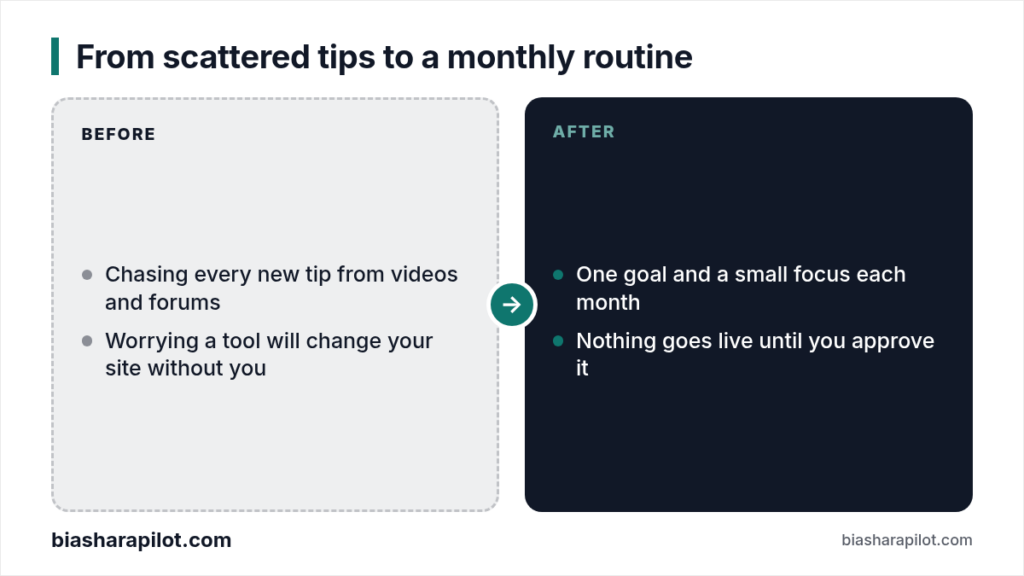
Once you start, you’ll see tips everywhere: a new video, a forum thread, a friend’s advice. Write them down for next month rather than changing course mid-month, so the work you started has time to show.
If a tip keeps coming up, it can earn a place in a later month’s focus. Your monthly numbers will tell you whether the plan is working before you change it.
Your first month, as a checklist
- List every page on your site and what it’s for.
- Mark the two or three pages that make you money.
- Search for your customers’ five main questions and note who’s on page one.
- Check Google Search Console for searches where you sit on page two.
- Write down one goal in a single sentence.
- Choose two articles and one page fix as the month’s focus.
- Set a date at the start of next month to look at the results.
Publish articles and link them to the pages that make you money
What a useful article looks like
A useful article answers one question a customer asks you, in the words you’d use on the phone. “How long does a water heater last?” is a better topic than “Plumbing tips”, because it matches what someone types and you can answer it fully.
Write the way you talk to customers: what causes the problem, what it costs them to wait, and what you’d recommend. Readers trust a page that sounds like the person who’ll turn up at their door.
No time to write every week?
We understand that writing every week is hard when you’re out on jobs all day. But you don’t have to start from a blank page.
In BiasharaPilot, articles are planned from your goal, drafted in your business’s voice and checked by a second AI reader, so your part is reading and approving. Every figure in a draft shows its source, so you know where each number comes from.
Each approved article can also become social posts in your brand’s colours for Facebook, Instagram, LinkedIn, TikTok, Threads and X.
Link articles to the pages that make you money
An article brings in someone with a question. A link inside it, on words like “water heater installation”, takes them to the page where they can book you.
Links also help Google see which pages on your site matter most. Add a few each week, from new and older articles to your money pages, on words that already fit the sentence.
Our weekly links work the same way. Each link goes onto words already on the page, so your sentences stay yours, and you see each one before it goes in.
Check every change before it goes in
A fear we often hear is that a tool will change or publish things on your site without you knowing. That’s a fair worry, given how some tools work.
In BiasharaPilot, nothing goes live until you approve it. What you approve goes on your site within a few minutes, and the plugin keeps a list of every change on your site, with an Undo on each one.
If something doesn’t look right after it goes live, press Undo on that change. You stay in charge of your own site, whichever steps you hand over.

Measure each month, then choose to do it yourself or with help
What to look at in a monthly report
Once a month, look at three numbers for each page: clicks, the searches it showed up for, and its position on Google. Compare them with last month and note what moved.
These numbers tell you how visible you are, not how much you sold. Match them against your own records of calls and bookings to see what the extra visitors are worth to you.
Our monthly reports arrive on the first of the month, topic by topic, and take about five minutes to read. They also check whether ChatGPT, Claude, Gemini and Perplexity name your business when asked your customers’ questions.
Why young articles aren’t judged yet
An article published last week has barely been found by Google. Judging it now could push you to rewrite or delete work that hasn’t had a chance.
That’s why our report doesn’t judge any article younger than four weeks. In the meantime, keep publishing to the plan, so each month adds to the last.
Do it yourself, use a tool, or hire help
You can learn SEO yourself from blogs, forums and YouTube videos, and many owners start that way. What matters is whether you have the hours to learn, write, link and measure every month on top of running your business.
| By hand | BiasharaPilot | Managed SEO from AM Digital KE | |
|---|---|---|---|
| Who does the steps | You do each one | Your studio does them, and you approve | Our team, using the same system |
| Your time each month | Learning, writing, linking and measuring | Approving drafts and links, plus a five-minute report | A monthly meeting with our team |
| Before anything goes live | You decide | Nothing goes live until you approve it | Our team reads every article |
| Price | Your own time | Set at launch | On amdigitalke.com |
| Fits you if | You enjoy learning and have the hours | You want a steady routine and to stay in charge | You want a team doing the work with you |
Our founder, Alvin, has spent ten years in SEO for agencies, media houses, ad companies, startups and WordPress companies. BiasharaPilot follows the same six steps every month, from connecting your site to the report: connect, read the site, plan, draft, publish, report.
It works with WordPress and Next.js sites today. Inside your studio, Rubani, your SEO and strategy partner, answers from your own numbers and plan, so you learn as you go rather than from generic guides.
The first step to take today
Whichever route you pick, start with the first two lines of the checklist: list your pages and mark the ones that make you money. That short list shapes your goal and every month’s focus after it.
Keep it somewhere you’ll see it. When next month comes, you’ll compare your numbers against it.
Frequently asked questions
How long does SEO take for a small business?
There’s no fixed date, and nobody can honestly give you one. New articles often need a few months to settle on Google, which is why a steady monthly routine matters more than any single page.
Is Rubani a person?
Rubani is the SEO assistant built into your studio. It answers from your own numbers and plan, and it can do what the screens do.
If you’d rather work with people from our team, that’s Managed SEO from AM Digital KE.
When does BiasharaPilot open, and what does it cost?
Early access opens in waves, starting with the first people on the list. The price is set at launch, and joining the list doesn’t commit you to anything.
Your next step
This week, spend an hour listing your pages and marking the ones that make you money. Then write your one goal at the top of that list.
If you’d like a routine that does the steps with you while you approve everything, join early access. You keep running your business, and nothing goes live on your site until you say yes.